
Introduction
The financial health of your Houston medical practice is under threat from medical billing denials. Nationally, 73% of providers report increasing denials. Given Houston’s complex payer landscape and over 19,000 licensed physicians, the challenge is acute. The average denial rate sits at 11.81% in 2024—a figure that directly impacts your bottom line. Effective medical billing denials prevention is not administrative cleanup; it’s a direct lifeline for cash flow and efficiency. Managing denied medical claims ensures your practice’s financial future. For a comprehensive approach, explore our essential backoffice solutions for Healthcare Practices.
Texas-specific requirements, such as BCBS Texas’s 95-day filing limit, add complexity. Proactive prevention, supported by industry statistics on rising denial rates, is the only viable path forward.

Understanding Medical Billing Denials in Houston's Healthcare Market
The Financial Impact of Denied Claims
The financial consequences of denied medical claims are severe. Reworking a single denial costs an estimated $25 per claim, and critically, nearly 60% of all denied claims are never resubmitted, becoming permanent lost revenue. In Houston’s competitive market, these losses are unsustainable. Navigating diverse payer contracts and Harris County Medicaid requirements presents unique local challenges. Adopting stringent medical billing best practices is essential to stop denials before they begin.
Current Denial Rate Trends
The scope of the problem is clear: denial rates climbed 2.4% to 11.81% in 2024, with about 15% of private payer claims initially denied. However, up to 90% of denials are preventable. This high preventability rate confirms that targeted strategies to reduce billing errors will yield substantial returns. We rely on comprehensive industry studies and reports to affirm that a well-executed prevention strategy is a necessity.
Common Causes of Medical Billing Denials
Coding Errors and Inaccuracies
Coding errors are a primary cause of denials, including incorrect ICD-10/CPT codes, unbundling, and modifier mistakes. The complexity of medical coding requires continuous education. Adhering to medical billing best practices demands meticulous, up-to-date staff to reduce billing errors. Practices must invest in certified medical coders and training programs, maintaining industry standards like CPC certification.
Insurance Verification Issues
Incorrect or outdated insurance information frequently results in denied medical claims. Failure to perform real-time eligibility verification before an encounter is a critical flaw. Common errors include assuming active coverage, verifying the wrong policy type, or missing secondary insurance. These issues are amplified by Texas’s diverse insurance landscape. For comprehensive verification solutions, review our services dedicated to insurance-verification.
Timely Filing Limit Violations
Violating payer-specific deadlines leads to automatic denials. These vary: BCBS Texas requires claims within 95 days, while Medicare allows one year. Additionally, Texas law requires providers to bill patients within ten months. Meeting these deadlines is a foundational element of effective medical billing denials prevention.
Prior Authorization Failures
Failing to obtain required prior authorizations guarantees an automatic denial. While authorization-related denials slightly decreased in 2024, they remain a major obstacle. Implementing a solid authorization tracking system is a crucial medical billing best practice to secure payment for covered services.
Practical Prevention Strategies for Houston Medical Practices
Implementing Comprehensive Staff Training Programs
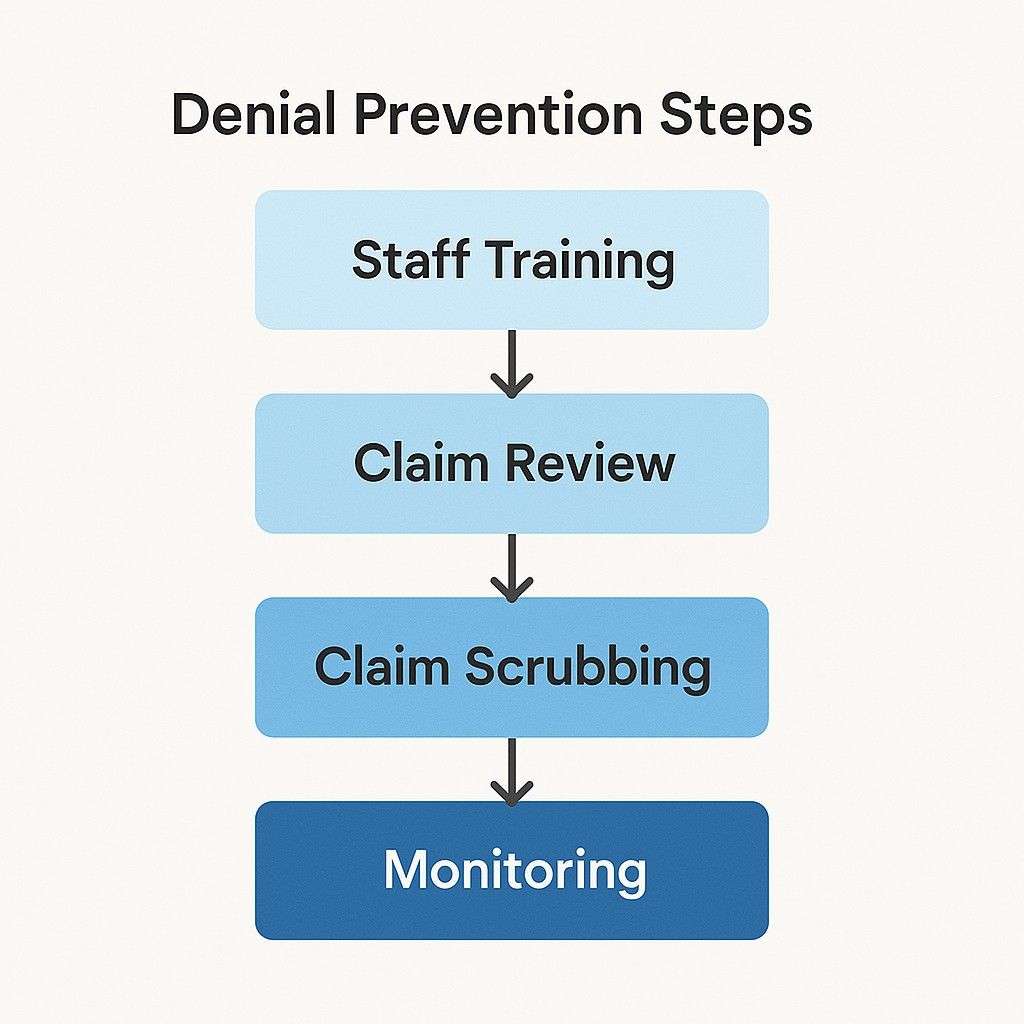
Ongoing education is critical due to constant changes in coding, payer rules, and regulations—changes that affect 75% of providers. Comprehensive training and maintaining proper certifications are essential to reduce billing errors. These programs establish the necessary medical billing best practices for a high-performing revenue cycle.
Establishing Robust Quality Assurance Processes
A strong Quality Assurance (QA) process is key to medical billing denials prevention. This involves internal audits and pre-submission claim reviews. Automated claim scrubbing tools can achieve acceptance rates up to 98%. Professional billing services utilize multi-layer QA to catch hidden errors.
Leveraging Technology Solutions
Modern billing relies on technology. AI-powered scrubbers, real-time eligibility verification, and automated coding validation tools significantly reduce billing errors. Integrating these tools with your EHR improves charge capture and leads to an estimated 95% reduction in data entry errors. Houston practices that embrace this technology adopt a core medical billing best practice.
Creating Effective Appeal Protocols
When denials do occur, a systematic management process is vital. With 83.2% of appealed denials being overturned, the appeal process is highly valuable. Proper protocols for reviewing denied medical claims, gathering documentation, and submitting timely appeals are essential for recovering lost revenue.
Building a Sustainable Denial Prevention System
Monitoring Key Performance Indicators
Sustained prevention requires rigorous KPI monitoring. Critical metrics include a clean claim rate (target >95%), denial rate (goal <5%), and days in accounts receivable (target <30 days). Tracking these KPIs against industry benchmarks is a foundational medical billing best practice to identify and target improvement opportunities.
Partnering with Professional Services
For many Houston practices, outsourcing to a professional service is the most effective strategy for medical billing denials prevention and to reduce billing errors. Specialized firms achieve denial rates under 2%, compared to the 10-15% industry average. This partnership provides expert knowledge and advanced technology. Learn more about comprehensive billing solutions.
Conclusion
The healthy revenue cycle for your Houston medical practice depends on proactive prevention. By addressing common causes like coding errors, verification issues, and timely filing limits, and implementing medical billing best practices through training and technology, your practice can secure its financial health. Remember, 90% of denials are preventable.
Reduce Denials: Learn About Medical Billing.

Next step
See how Synectus closes the handoff after the lead arrives.
If this article describes the exact gap inside your clinic, go one layer deeper into the service stack or book a direct strategy call with Synectus.