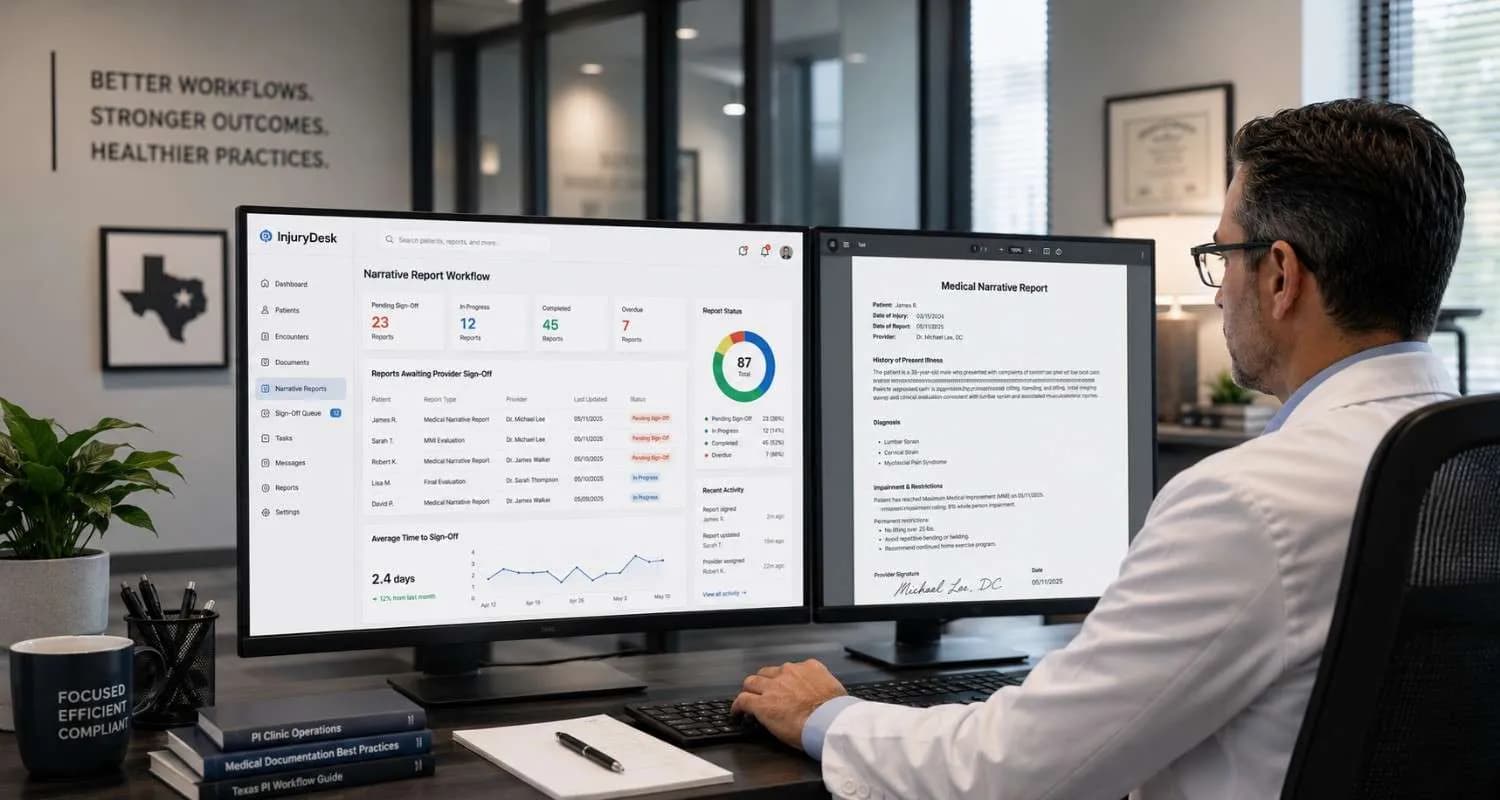

Your Texas personal injury (PI) clinic’s waiting room is full. Your providers are booked out for weeks. From a strictly operational standpoint, patient volume looks incredibly healthy. But when the quarter ends and you review your actual collected revenue from Letter of Protection (LOP) settlements, the numbers do not align with the sheer volume of patients treated.
The problem? You are measuring the wrong metric. Most Texas PI clinics measure referral volume, completely blind to referral profitability.
If you ask a clinic owner who their best referral source is, they will instantly name the attorney who sends them 40 cases a month. But what if those 40 cases consistently result in 60% bill reductions, require excessive administrative back-and-forth, and take 24 months to settle? Meanwhile, another attorney sends 10 cases a month that settle in 9 months at 95% of the billed ledger.
Without a sophisticated PI clinic referral source tracking system Texas clinics rely on manual spreadsheets and gut feelings. This operational blindness leads to wasted marketing capital, misallocated administrative resources, and a dangerous over-reliance on unprofitable relationships. This guide breaks down why standard referral tracking fails, the hidden risks inside your referral data, and how to build an infrastructure that ties patient intake directly to settled revenue.
Why Most Texas PI Clinics Track Referrals Incorrectly
The fundamental flaw in most personal injury clinic operations is how referral data is captured at the front desk. The standard process relies on a single dropdown menu in the EHR during patient intake: "How did you hear about us?"
This static data point fails because it captures the origin of the patient but completely disconnects that origin from the financial outcome. Tracking referrals correctly requires continuous data flow, not a one-time entry.
When clinics track incorrectly, they suffer from a dangerous referral concentration ratio. This ratio measures how much of your actual settled revenue is tied to a specific referral source. If your tracking system only shows volume, you might realize too late that 80% of your profitable LOP cases come from just two law firms. If one of those firms shifts their preference, your clinic's cash flow collapses, even if your overall patient volume remains temporarily high from lower-tier sources. A proper tracking system flags this ratio in real-time, giving you the data needed to force a multi-channel risk discussion and diversify your acquisition strategies before a crisis hits.
The Difference Between Referral Volume and Referral Profitability
Volume is an ego metric. Profitability is a survival metric. In the Texas PI ecosystem, a patient generated from an attorney referral is not a guaranteed dollar amount; it is a liability that your clinic must manage until settlement.
To separate volume from profitability, your tracking system must calculate a referral stability score for every source. This score is not based on how many patients an attorney sends, but rather a composite metric evaluating:
- Settlement Velocity: How fast do this source's cases actually close?
- Reduction History: Does this attorney consistently fight the adjuster to protect your medical bills, or do they immediately ask your clinic to take a 50% cut to save the settlement?
- Operational Friction: How many times does this source's paralegal team request the same medical records fulfillment package?
When you track the stability score, you quickly realize that the law firm sending you high volumes of low-impact, heavily reduced cases is actually costing your clinic money in administrative overhead and delayed cash flow.
Why Spreadsheet Referral Tracking Fails at Scale
Many clinics attempt to solve this visibility problem by having an office manager maintain a master Excel spreadsheet. This is a structural failure waiting to happen.
Spreadsheets fail at scale because they rely on manual data entry, which is inherently flawed when managing complex LOP workflow lifecycles. The patient intake occurs in the EHR, the billing happens in a separate clearinghouse software, and the legal communication happens via email. A spreadsheet cannot dynamically sync these disparate data points.
When a case is dropped, an attorney is swapped, or a settlement check arrives 18 months later, the spreadsheet is rarely updated accurately. This results in "ghost data"—analytics that look complete but are entirely disconnected from reality. You cannot make strategic clinic growth decisions or evaluate attorney partnerships based on a broken Excel file.
The Hidden Cost of Not Knowing Your Best Referral Sources
When you cannot attribute settled revenue back to its exact origin, you cannot protect your clinic's future. The hidden costs extend far beyond just accepting bad settlements.
Consider attorney retirement exposure. The Texas PI landscape is evolving. If your tracking system is broken, you might not notice that the senior partners at your most profitable referring law firms are scaling back their caseloads. Without data telling you to pivot, you are entirely exposed when they retire. A dynamic tracking system forces you to look at the cohort data and alerts you to build relationships with younger, high-velocity firms before your primary revenue source ages out.
Furthermore, lack of data prevents you from conducting a true competitive gap analysis. If you do not know the precise profitability of a specific law firm's referrals, you do not know if your competitors are successfully poaching their high-value commercial policy cases while leaving your clinic with the minimum-limit auto accident cases. Data visibility is your only defense against being downgraded by your own referral partners.
How Referral Attribution Breaks Across Multi-Location Clinics
For Texas PI practices scaling across multiple locations—such as managing offices in Houston, Dallas, and San Antonio—referral tracking becomes exponentially more complex.
An attorney might refer to a patient who lives in Dallas but works in Fort Worth. The patient does their initial intake at your Dallas clinic but completes their physical therapy at the Fort Worth location. If your referral source tracking system cannot unify data across facilities, that single referral is split, duplicated, or lost in the reporting.
Multi-location clinics require a unified data architecture where the referral source is hardcoded to the patient's master file, regardless of where the individual treatments occur. This ensures that the referring attorney gets full credit for the case, and your executive team can accurately evaluate regional marketing performance.
Building a PI Clinic Referral Source Tracking System Texas Practices Can Scale
Moving from guesswork to precision requires implementing a closed-loop attribution system. This system must connect the front-end patient acquisition directly to the back-end revenue cycle.
Here is the architectural blueprint for a functional PI clinic referral source tracking system Texas practices need:
- Dynamic Intake Capture: Replace static dropdowns with conditional logic during the Texas PI clinic patient intake process. Automatically log the exact attorney, paralegal, or digital channel that generated the patient.
- EHR and Billing Synchronization: The system must pull the billed ledger data directly from the EHR and attach it to the specific referral source ID.
- Settlement Reconciliation: When the LOP settles and the final check clears, the system must automatically calculate the variance between the billed amount and the collected amount, assigning that percentage directly to the attorney's ongoing stability score.
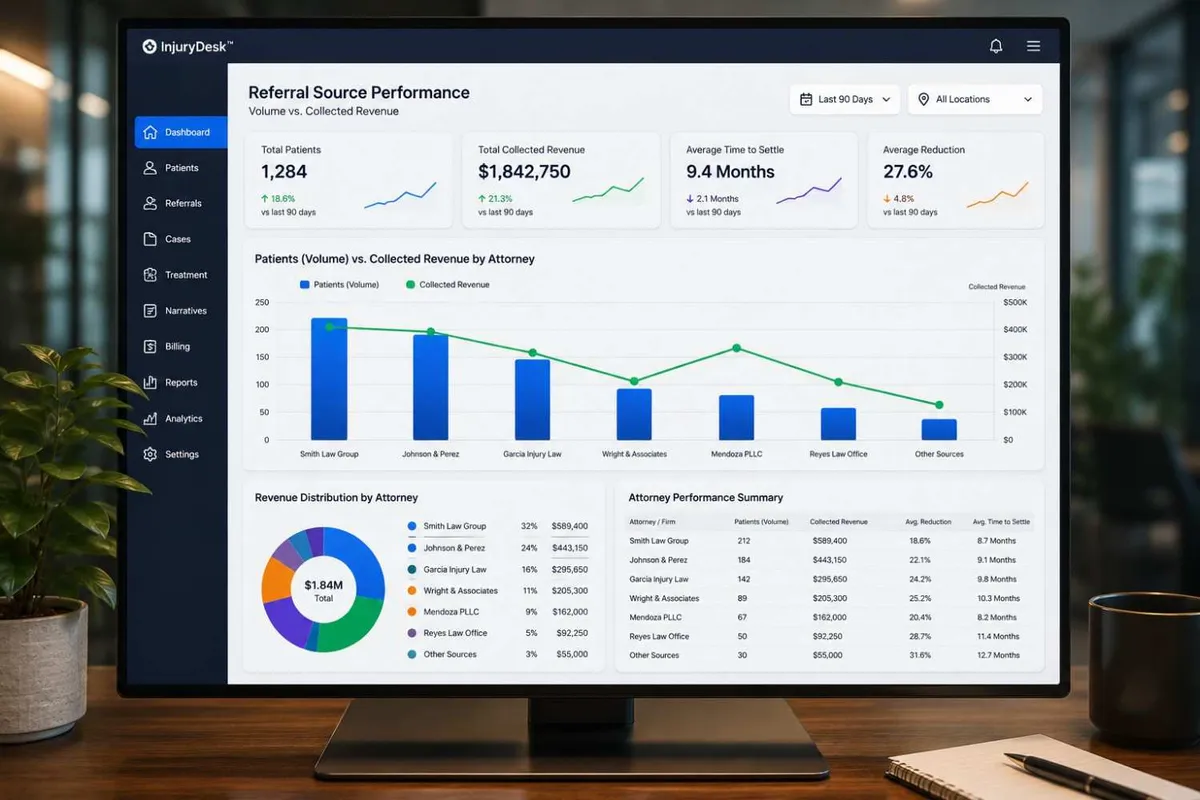
- Automated Reporting Dashboards: Management must have real-time access to cohort analysis, instantly identifying which channels are driving high-margin outcomes and which are draining resources.
How InjuryDesk™ Connects Referral Data to Revenue Outcomes
Building this infrastructure from scratch is technically overwhelming for most medical practices. This is exactly why Synectus integrates advanced referral analytics directly into InjuryDesk™. This reporting framework is part of the Synectus™ PULSE Method™, which connects patient acquisition, referral analytics, legal workflows, and settlement outcomes into a single operational system.
InjuryDesk is engineered specifically for the PI legal workflow. It eliminates the spreadsheet entirely. When a patient enters the system, InjuryDesk tracks their entire lifecycle—from the initial evaluation through every treatment, the final medical narrative, the demand letter phase, and the ultimate settlement check.
InjuryDesk automatically generates real-time reports on attorney performance. It shows you exactly which law firms have the highest settlement velocity, which firms demand the steepest reductions, and which digital marketing campaigns are actually converting into profitable LOP case tracking outcomes. It turns raw patient data into actionable financial intelligence.

Creating Referral Visibility Across Every Attorney Relationship
Once you have a functional tracking system, your relationship with referring attorneys fundamentally changes. You are no longer taking them to lunch just to "check in" and beg for cases.
Armed with hard data, you can conduct quarterly performance reviews with your top referral partners. You can confidently sit down with an attorney and say, "Over the last six months, we successfully treated 25 of your clients. We delivered our medical narratives within 48 hours of MMI, which helped your team settle these cases 20% faster than your average. Let's discuss how we can handle your commercial policy cases next quarter."
Data transforms your clinic from a replaceable medical vendor into a strategic operational partner. By tracking the metrics that actually matter, you protect your margins, secure your best relationships, and aggressively scale your profitability.
Book a Free Referral Analytics Audit
Stop operating in the dark. If you do not know the exact profit margin of your top three referral sources, your clinic is leaking revenue.
Synectus provides a comprehensive audit framework to evaluate your current data infrastructure. We analyze your intake protocols, your EHR setup, and your PI clinic cash flow to identify the gaps in your referral tracking. Book a free audit today, and let us show you how to implement a tracking system that guarantees you know exactly where your revenue comes from.
Related reading
Next step
See how Synectus closes the handoff after the lead arrives.
If this article describes the exact gap inside your clinic, go one layer deeper into the service stack or book a direct strategy call with Synectus.