
If your Texas PI clinic is generating leads but still losing patients, the problem almost certainly lives inside your Texas PI clinic patient intake process — not your marketing. Most PI clinic owners invest in ads, SEO, and referral networks, but the data tells a different, more expensive story: the majority of case losses happen within the first 24 hours after a patient makes contact, long before treatment ever begins. The intake stage is where revenue is either locked in or silently lost, where attorney relationships are built or broken, and where growing clinics plateau despite strong lead volume. This is not a marketing failure. It is an operations failure — and for Texas PI clinics, it is costing thousands of dollars per week in case of leakage that never shows up on any report.
The First 24 Hours That Decide Whether a PI Case Is Won or Lost
The window between a patient's first contact with your clinic and their confirmed first appointment is the single most revenue-critical stage in the PI case lifecycle. Health Affairs research shows that healthcare providers responding to patient inquiries within the first hour are significantly more likely to convert those inquiries into appointments. For PI clinics operating on lien-based models, this urgency compounds rapidly.
PI patients are often in active pain, in ongoing legal proceedings, and being contacted simultaneously by multiple providers. If your intake team takes 4–6 hours to respond, your clinic has effectively already lost that case — even if the patient never formally notifies you. Beyond that single patient, the damage multiplies: each lost intake represents missed treatment revenue across the full care cycle, a weakened LOP (Letter of Protection) opportunity, a missed billing event, and a damaged referral relationship with the attorney who sent that patient to you. The first 24 hours are not a warm-up. They are the case.
Where PI Clinics in Texas Break During the Texas PI Clinic Patient Intake Process

The failure point inside the Texas PI clinic patient intake process is almost never obvious from the outside. Clinics don't lose cases because of bad staff. They lose cases because their systems are fragmented, manual, and built for volumes that no longer reflect their current reality.
Here is where the breakdown consistently happens:
Manual intake forms with no automation.
Staff collect patient information over the phone or through paper forms. Data entry is delayed. Intake files are incomplete. Cases fall through because no single person owns the follow-through from first contact to confirmed appointment.
No standardized intake workflow.
Each staff member handles intake differently. There is no checklist, no time-bound response protocol, and no escalation trigger for missed contacts. This inconsistency means case conversion varies entirely based on who happens to pick up the call.
Missing critical data at first contact.
If the clinic fails to capture the accident date, insurance carrier, and attorney referral source in the first interaction, it creates compounding delays across billing, verification, and LOP execution that can push case start dates back by days.
No first-response SLA.
Most PI clinics have no formal internal policy governing how quickly a lead must be contacted. The American Academy of Pain Medicine recognizes response time as a direct driver of patient conversion rates in specialty clinics. Without a defined window, staff respond when capacity allows — which is not fast enough in a competitive Texas PI market.
This is a system design failure. The only sustainable fix is a structured, automated patient intake workflow automation that runs consistently regardless of staff availability, training level, or volume spikes.
Intake-to-Scheduling Gaps That Quietly Kill Case Conversion
Even when a clinic successfully captures a patient at intake, the gap between intake completion and appointment booking is where a second round of case loss occurs — silently and without any visible alert to clinic leadership.
Consider this sequence: A PI patient calls on Monday morning. The intake coordinator completes the intake form. The file is passed to the scheduling team. The scheduler is handling three other calls and a walk-in. No appointment is confirmed until Tuesday afternoon — 28 hours later. By then, the patient has already visited a competitor clinic that had an automated booking confirmation in their inbox within 15 minutes of their first call.
The intake-to-scheduling gap produces several cascading failures: no appointment confirmation means no patient commitment, no reminder automation means high no-show rates even when appointments are booked, and no scheduling visibility means clinic leadership cannot see real-time conversion data. A structured PI clinic operations system in Texas closes this gap by connecting intake data directly to scheduling workflows, triggering automated confirmations, and assigning ownership at every handoff point so no case moves forward without a timestamped checkpoint.
Insurance Verification Delays That Stop Treatment Before It Starts
The insurance verification stage is where operationally weak PI clinics lose cases that their intake team worked hard to capture. In Texas, the PI clinic environment requires fast, accurate eligibility verification — because treatment on lien often begins before traditional insurance coverage is fully confirmed.
When verification is manual, staff-dependent, and disconnected from the intake workflow, the following chain reaction begins: verification requests sit in an inbox for 12–48 hours, staff follow up by phone with carriers adding another 24–72 hours to the process, treatment is delayed pending verification results, and the patient — still in active pain and still legally time-sensitive — abandons the process and contacts another clinic.
The Texas Department of Insurance outlines clear timelines for insurance eligibility responses, yet most PI clinics never leverage these regulatory frameworks to accelerate their own internal verification processes. Implementing an automated insurance verification system that connects directly with carriers, logs verification status in real time, and gates scheduling only upon confirmed eligibility eliminates this delay point entirely — keeping cases moving from intake to treatment without staff bottlenecks.
Lack of Attorney Communication During Intake Stage
One of the most overlooked failure points in the Texas PI clinic patient intake process is the complete absence of attorney notification at the intake stage. In personal injury cases, the referring attorney is a critical stakeholder from day one — yet most PI clinics don't notify the attorney that their referred patient has arrived, been intake-processed, or been scheduled until days after the fact.
This communication breakdown drives serious, long-term referral relationship damage. Attorneys lose confidence in clinics that cannot confirm patient receipt in real time. Delayed LOP communication stalls case acceptance on the legal side. Without real-time status sharing, attorneys spend time chasing clinics for updates — creating friction that reduces future referral volume over time. Worse, missed LOP setup at intake delays billing across the entire case duration.
The PI legal workflow automation system from Synectus™ addresses this with automated attorney notifications at each intake milestone, structured LOP workflows, and a shared case status portal that gives attorneys real-time visibility without requiring a single manual follow-up from your front desk. This is what converts an attorney referral relationship from transactional to long-term.
Why Most PI Clinics Have No Visibility Into Early Case Drop-Off
Here is the systemic problem that makes all of the above invisible: most Texas PI clinics have zero data on their intake conversion rate.
Clinic owners know how many patients they have treated. They rarely know how many patients contacted them and never came in. The drop-off between first contact and first appointment is completely untracked — which means it cannot be measured, managed, or improved. PI clinic revenue leakage at the intake stage is the most expensive blind spot in clinic operations.
The Healthcare Financial Management Association benchmarks suggest that specialty clinics without intake automation lose 20–35% of inbound leads before the first appointment is ever confirmed. No-show rates spike without reminder automation. Staff accountability for case loss is impossible without timestamped workflow data. Growing clinics scale their patient acquisition spend without fixing the intake leak — spending more money to lose more cases at the same invisible rate.
The first step in fixing the patient intake failure PI clinics face is installing measurement. The second step is automation. Synectus™ builds both inside one connected operating framework.
How InjuryDesk™ Fixes the First 24-Hour Intake Failure Point
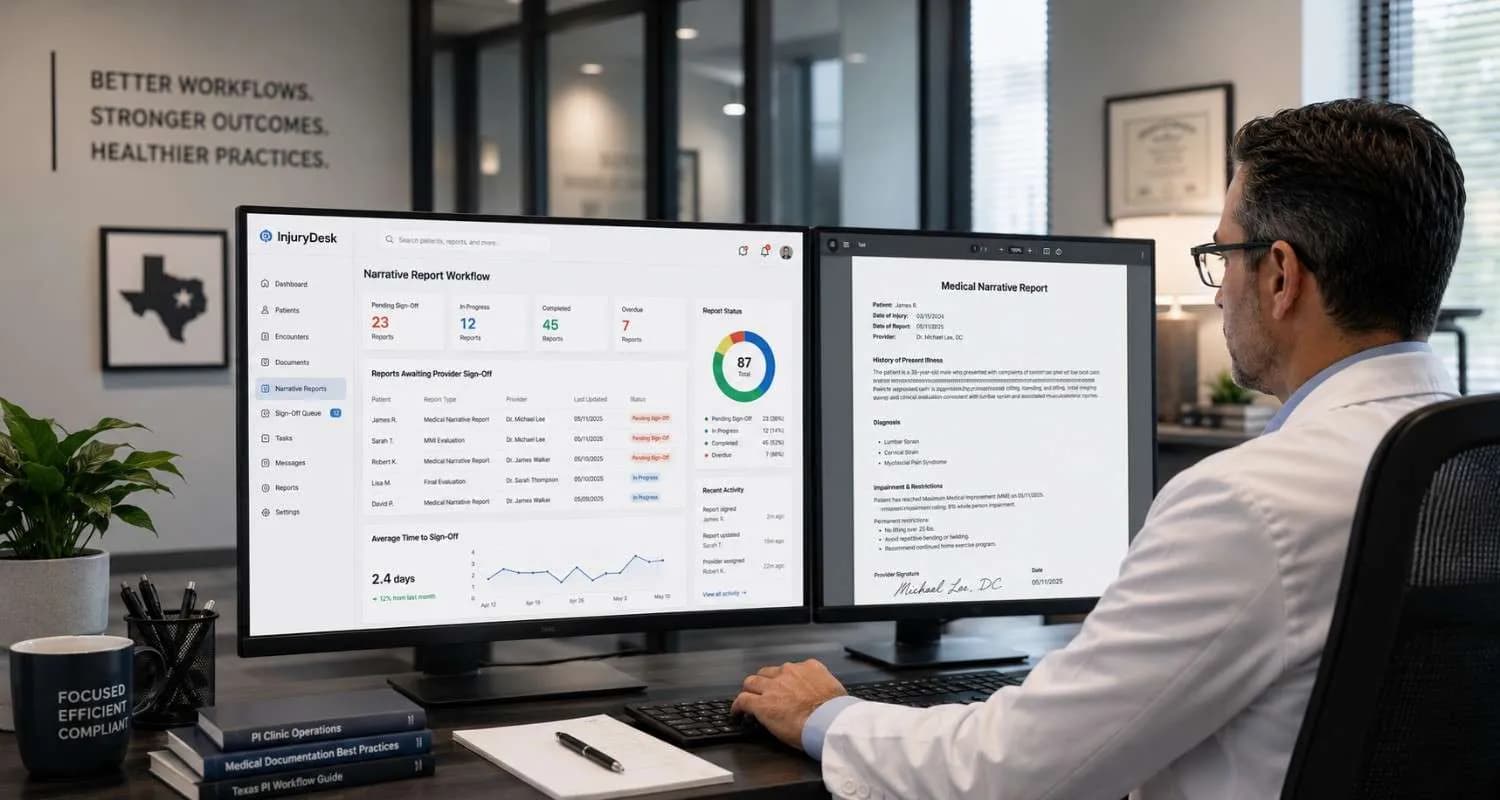
InjuryDesk™ PI clinic management software was purpose-built to eliminate the 24-hour failure window that costs Texas PI clinics cases, revenue, and attorney relationships every single week.
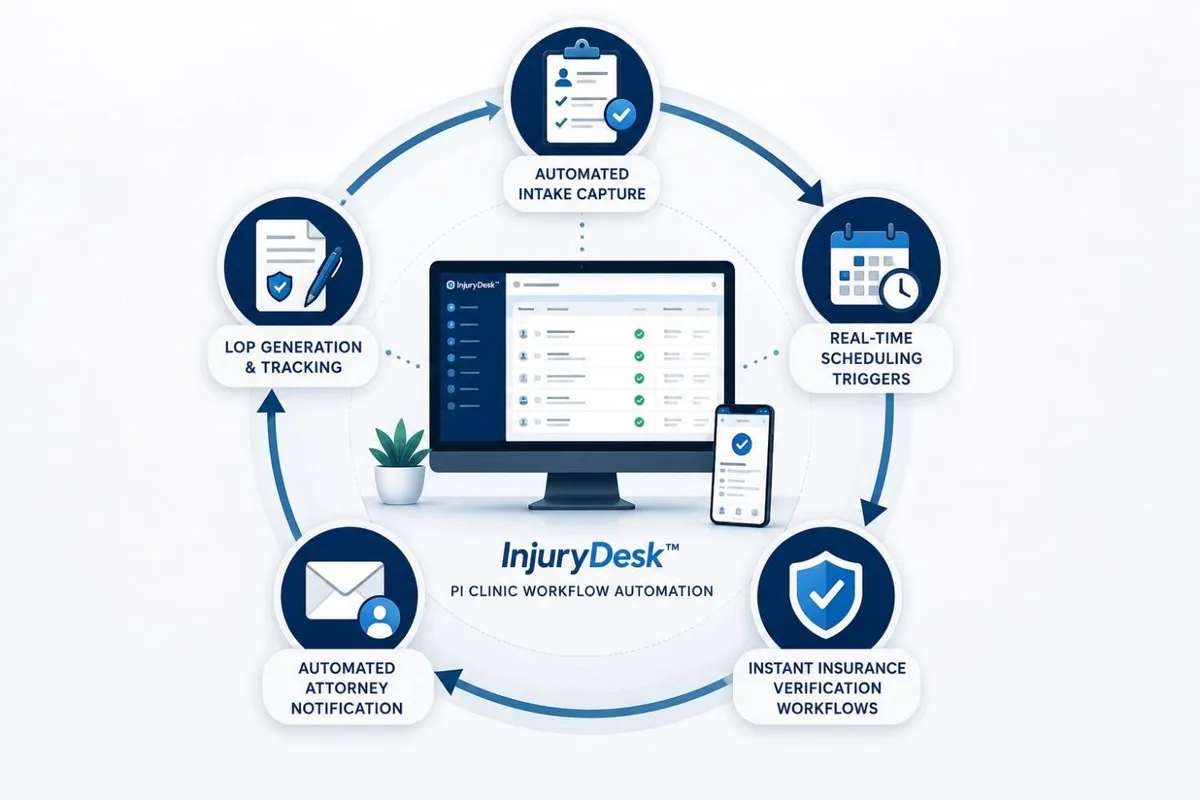
Here is what InjuryDesk™ delivers at each stage of the intake failure chain:
Automated intake capture
Digital intake forms trigger the moment a patient makes contact, collect all required case data, and immediately route the file to the correct workflow stage with no manual entry dependency.
Real-time scheduling triggers
Once intake is complete, InjuryDesk™ automatically pushes the case to the scheduling queue, sends the patient a confirmed appointment, and activates automated reminder sequences with no staff involvement.
Instant insurance verification workflows
Verification requests are sent automatically at intake and tracked in real time within the InjuryDesk™ dashboard. No inbox delays. No staff chasing carriers.
Automated attorney notification
The referring attorney receives an immediate case receipt confirmation at intake, followed by structured status updates at each milestone — without a single manual follow-up from your team.
LOP generation and tracking
Letter of Protection workflows are triggered at intake, managed through InjuryDesk™ 's attorney portal, and tracked through to settlement with a full audit trail.
This is what clinic workflow automation Texas means in operational practice — not a generic software platform, but a PI-specific system that understands lien models, attorney workflow dependencies, and the Texas PI clinic volume environment.
Building a Zero-Leak Intake System for Texas PI Clinics Using the PULSE Method™
Applied to the Texas PI clinic patient intake process, the PULSE Method™ operates as follows:
P — Pipeline:
Build the patient acquisition channels that deliver qualified PI patients ready for intake — not cold traffic that stalls at the first contact point. The referral sources, campaigns, and intake triggers are aligned from day one.
U — Usher:
Guide every incoming patient through a structured, automated intake process with zero manual dependencies. The patient is ushered from first contact to confirmed appointment with automated checkpoints at every stage.
L — Look After:
Maintain full case visibility from intake through to settlement. No cases fall through. No attorneys are left without updates. No billing gaps from missing intake documentation.
S — Support:
Provide continuous operational support across intake, scheduling, and verification so clinic staff focus entirely on patient care — not administrative firefighting.
E — Execute:
Deliver the complete workflow — intake automation, attorney-clinic workflow systems, LOP management, and InjuryDesk™ reporting — as a connected, measurable, accountable operating system.
The zero-leak intake infrastructure Synectus™ builds for Texas PI clinics includes PI case management software (InjuryDesk™) for end-to-end case visibility, lien management for PI clinics embedded into every intake workflow, medical billing automation Texas protocols connected to verified intake data, PI clinic revenue leakage dashboards, and fully HIPAA-compliant patient intake forms and data routing throughout every touchpoint.
According to the U.S. Department of Health and Human Services, HIPAA compliance in patient data collection is a non-negotiable regulatory requirement. Every Synectus™ intake system and InjuryDesk™ workflow is built HIPAA-compliant by default — removing compliance risk entirely from the clinic's operational burden.
The result: PI clinics applying the full PULSE Method™ through Synectus™ see intake conversion improvements within 30 days, alongside measurable reductions in lien processing time, attorney communication friction, and administrative overhead per case.
Book Your Free PI Clinic Intake Optimization Strategy Call
The Texas PI clinic patient intake process does not need more staff. It needs a system — one that captures every patient, closes every intake gap, routes every LOP, and notifies every attorney without your team managing it manually.
Synectus™ offers a free, no-obligation book your free PI clinic strategy call where our Texas-based operations team will:
- Audit your current intake workflow stage by stage and identify every leak point
- Show you exactly where your clinic is losing cases within the first 24 hours
- Demonstrate how InjuryDesk™ and the PULSE Method™ close those gaps with measurable outcomes
- Deliver a specific, actionable intake optimization plan — not a generic agency pitch
Texas-based team. Same-day response. No contracts required to start.
Related reading
Next step
See how Synectus closes the handoff after the lead arrives.
If this article describes the exact gap inside your clinic, go one layer deeper into the service stack or book a direct strategy call with Synectus.