
According to a recent statistic, a staggering 76% of “near me” mobile searches result in a business visit within 24 hours. For a pain management practice in Houston, Texas, this statistic is not just a number—it’s the cornerstone of patient acquisition. If your practice isn’t showing up when a Houstonian searches for pain relief “near me,” you’re effectively invisible to those who need you most.
The vast, competitive Houston medical market presents unique challenges. With over 7.3 million residents spread across a sprawling metropolitan area, reaching the right patient at the right time requires more than just a great reputation; it demands a precise and effective Local SEO Keywords Pain Management Houston strategy.
This post will guide Houston medical practices through the essential steps of identifying and utilizing the specific local keywords—service-specific + location, condition-specific + location, and symptom-specific + location terms—that connect you directly to patients actively seeking care. To understand how these keywords fit into your broader digital strategy, start with our guide on Early mention of broader local SEO principles.
Understanding Local SEO Keywords for Pain Management Practices
Local SEO keywords are the precise phrases patients use when they are looking for a medical service in a specific geographic area. For a pain management practice, these keywords are the vital link that distinguishes your office from a general hospital or a national chain. Unlike broad medical keywords, local terms instantly convey high intent and geographic relevance.
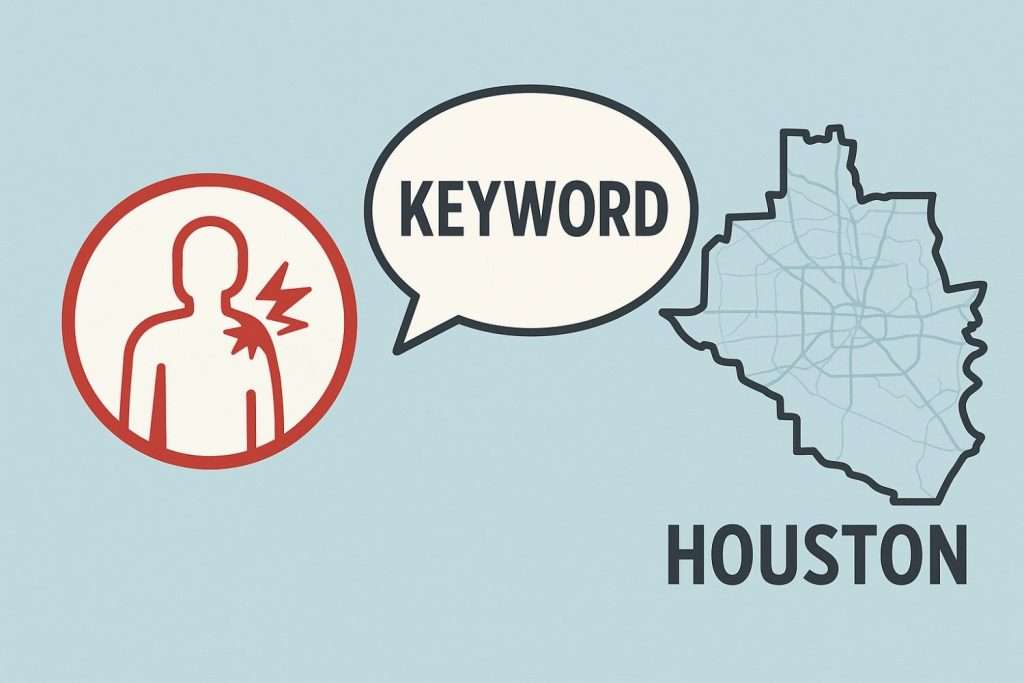
Our strategy for Houston focuses on three core, high-intent categories:
- Service-Specific + Location: Targeting the exact procedures you offer.
- Condition-Specific + Location: Focusing on the ailments patients are seeking to treat.
- Symptom-Specific + Location: Capturing early-stage searchers who haven’t received a formal diagnosis.
For practices in the Greater Houston area, simply using Pain Clinic Keywords Houston isn’t enough. You must also consider the city’s distinct and expansive geography. A patient in the Energy Corridor needs to find your practice just as easily as one near the Medical Center or Galleria. Research shows that pain management searches, given the urgency of relief, have exceptionally high local intent, making this focused keyword strategy non-negotiable for practice growth.
Service-Specific Keywords for Houston Pain Management
This category targets patients who already know the specific treatment or procedure they require. Optimizing for these keywords ensures your practice is visible when a patient is making an informed decision about where to get a treatment they’ve already researched.
To dominate this niche, your website must be optimized for long-tail, procedure-focused terms combined with Houston modifiers. Examples include:
- “Trigger point injections Houston”
- “Epidural steroid injections Houston”
- “Nerve block therapy Houston”
- “Chronic pain management Houston”
Implementing an effective Houston Pain Mgmt SEO strategy means extending your reach beyond the downtown area. Think hyper-locally. Your website and Google Business Profile (GBP) should utilize location modifiers for specific suburbs and neighborhoods like The Woodlands, Sugar Land, Katy, and Pearland to capture patients in those immediate service areas. By meticulously matching the services you offer with the exact search terms used by patients, you position your practice as the most relevant local authority.
Condition-Specific Local Keywords
Many patients begin their search by identifying a chronic condition they are suffering from. This category captures a more educated searcher who is seeking specialized care for a long-term issue.
These keywords combine the specific medical condition with your service area:
- “Fibromyalgia treatment Houston”
- “Arthritis pain Houston”
- “Neuropathy specialist Houston”
- “Migraine treatment Houston”
- “Sciatica doctor Houston”
The strategic use of Local SEO Keywords Pain Management Houston in this context is paramount. It signals to search engines and potential patients that your practice specializes in managing complex, specific conditions, not just general aches. Given the complexity of pain conditions, accurately representing your specialization in your keyword strategy is essential for building trust and attracting the right patient demographic across Houston.
Symptom-Specific Keywords and Patient Search Behavior
This category captures patients at the very beginning of their patient journey—when they are searching by their symptoms, often before receiving a formal diagnosis. These are often the highest-volume local searches.
Targeting symptom-specific + location keywords helps you capture the widest net of potential patients:
- “Lower back pain Houston”
- “Knee pain relief Houston”
- “Neck pain specialist Houston”
- “Joint pain treatment Houston”
Phrases like Find Pain Doctor Houston are direct examples of the patient-oriented language you must incorporate to meet this early-stage searcher. Considering Houston’s climate and common work environments e.g., office work, industrial sectors, common symptoms like lower back and joint pain are highly prevalent. Capturing this patient journey from initial symptom awareness to actively seeking treatment is critical for sustained practice growth.
Essential Keyword Research Tools for Pain Management Practices
Effective implementation requires data. You must move beyond guessing what patients are searching for and instead use tools to find concrete search volumes and competition data for the Houston area.
To gain a competitive edge, use a mix of free and paid resources:
- Free Tools: Google Keyword Planner, Google Autocomplete an excellent source for symptom-based queries, and Answer the Public reveals question-based searches.
- Paid Tools: SEMrush and Ahrefs provide comprehensive data on Houston-area search volume, competitor rankings, and advanced analysis.
The key is the Houston-specific application. Use these tools to filter results by geographic location, ensuring you are targeting terms with local search volume, rather than national. Remember, a keyword’s search intent is often more important than its volume alone. For broader fundamentals on keyword identification, read our guide on keyword research fundamentals.

Implementing Your Keyword Strategy
Research is only the first step; the true success lies in implementation. Your meticulously researched keywords must be strategically woven into all aspects of your digital presence.
- Website Optimization: Integrate service-specific keywords into your main service pages and use condition-specific terms for blog content.
- Google Business Profile (GBP): Use your keywords in your business description, services list, and even when responding to patient reviews.
- Content Creation: Develop hyper-local blog posts addressing the keywords e.g., “The Best Treatment for Sciatica Relief in Katy, TX”.
- Local Directory Listings: Maintain consistent NAP (Name, Address, Phone Number) across all major directories.
For practices serving multiple Houston-area communities, you must implement dedicated, optimized location pages for areas like The Woodlands or Sugar Land. Remember that as a pain management practice, you must maintain absolute medical accuracy and adhere to HIPAA compliance and ethical marketing guidelines, avoiding any form of keyword stuffing that could compromise your credibility or patient trust.
Measuring and Tracking Keyword Performance
A keyword strategy is a living document that requires continuous measurement and adaptation. Establishing clear Key Performance Indicators (KPIs) ensures your efforts are translating into patient acquisition.
Key tracking tools for a pain management practice include:
- Google Analytics: To track appointment bookings and form submissions originating from organic search.
- Google Search Console: To monitor which search queries are bringing patients to your site and identify technical issues.
- Local Rank Tracking Tools: To track your practice’s ranking for your specific service- and condition-based Houston keywords.
Critical Houston-specific metrics include local search visibility, the volume of calls placed directly from your GBP listing, and appointment bookings from organic traffic. It is imperative to connect these tracking efforts directly to patient acquisition and practice growth, always prioritizing patient privacy and ethical data practices. Explore a broader understanding of SEO strategy by visiting broader SEO strategy context.
Conclusion
Mastering your Local SEO Keywords Pain Management Houston strategy is the most effective way to ensure that patients in need find your practice. By focusing on the three pillars—service-specific + location, condition-specific + location, and symptom-specific + location—you create an organic pipeline that consistently delivers high-intent patients to your door. A proper local keyword strategy doesn’t just improve rankings; it directly connects your pain management expertise with the Houstonians seeking lasting relief.
For a broader understanding of how this strategy fits into your entire digital presence, review our Local SEO Mastery for Medical Practices.
Ready to stop guessing and start dominating the local search results for your pain management practice?
Next step
See how Synectus closes the handoff after the lead arrives.
If this article describes the exact gap inside your clinic, go one layer deeper into the service stack or book a direct strategy call with Synectus.