
If you run a personal injury clinic in Texas, you already know the rhythm: an attorney sends a patient over on a Letter of Protection (LOP), you treat them, you wait for the case to settle, and then — eventually — you get paid. Repeat. That model worked for years. But in today's personal injury clinic marketing Texas landscape, it's quietly becoming a ceiling, not a floor.
Here's the uncomfortable truth most clinic owners don't want to face: your competitors are no longer waiting for attorney referrals. They're showing up on Google before a patient ever picks up the phone to call a lawyer — and they're capturing that patient first. After 10 years building growth systems for Texas PI clinics, Synectus has seen this shift play out market by market, from Houston to Laredo to Beaumont.
The real problem isn't that you lack patients. It's where you're not looking.
Why Attorney Referrals Alone Are No Longer Enough for Texas PI Clinics
Attorney referrals built this industry. They're not going away. But treating them as your only patient acquisition channel in 2026 is the equivalent of running one ad on one radio station and calling it a marketing strategy.
The traditional model works like this: attorneys control the flow of patients, clinics depend on the volume those attorneys choose to send, and growth becomes a function of relationship maintenance rather than business development. It sounds stable — until it isn't.
The problems with referral-only dependence are structural:
Unpredictable pipeline.
When a referring attorney hits a slow quarter, so do you. Your schedule gaps have nothing to do with your clinical quality and everything to do with one attorney's caseload.
LOP billing delays compound the problem.
Letters of Protection tie your revenue to case settlement timelines that can run 12–24 months. Combine that with a dry referral month and your cash flow suffers twice — fewer patients coming in and slower payments from existing cases.
You have zero control over growth.
If you want 20% more patients next quarter, what's the plan? Call your attorneys and hope they send more? That's not a growth strategy. That's a wish.
In high-competition Texas PI markets like Houston, Laredo, and Beaumont, the clinics scaling past this ceiling have made a deliberate decision: referrals are a channel, not a strategy. The ones growing fastest have invested in personal injury clinic marketing Texas systems that work independently of any single attorney relationship.
Learn how the hidden cost of billing friction silently drains PI clinic revenue even when patient volume looks healthy.
How Patients Now Find Injury Clinics on Google — Before Contacting an Attorney

This is the shift that most PI clinic owners miss entirely, and it's arguably the most important behavioral change in the industry over the last five years.
After a car accident, a slip and fall, or a workplace injury, the first thing most patients do is not call an attorney. They open Google and search:
- "car accident doctor near me"
- "chiropractor after car accident Texas"
- "injury clinic Houston no insurance"
- "pain management after auto accident Laredo"
These searches happen within hours — sometimes minutes — of an accident. And whoever shows up in the Google Map Pack for those searches gets the call first. Not the attorney. The clinic.
This creates a dynamic that most clinic owners haven't fully processed: Google is now upstream of the attorney.
When a patient finds your clinic first, calls your intake team, and gets an appointment scheduled — they often ask you which attorney to use. You've just flipped the referral model on its head. Instead of being dependent on attorneys for patients, you become a source of patients for attorneys.
That's leverage. That's a growth system. And it starts with ranking in local search for personal injury clinic marketing Texas terms before your competitor does.
The 3 Digital Marketing Mistakes Texas PI Clinics Make That Cost Them New Patients
Most Texas PI clinics that attempt digital marketing run into the same three failure points. Understanding them is the first step to fixing them. In fact, the biggest gap in personal injury clinic marketing Texas isn't budget — it's strategy and execution at each of these three levels.
Mistake 1: No Local SEO Strategy
Showing up in Google Maps for injury-related searches doesn't happen by accident. It requires a fully optimized Google Business Profile, consistent NAP (name, address, phone) citations across the web, geo-targeted service pages, and a review generation system. Most PI clinics have a GBP listing that's partially filled out and hasn't been touched in two years. Meanwhile, competitors with a disciplined local SEO strategy are capturing every search in your area.
Mistake 2: Working With Generic Marketing Agencies
A standard digital marketing agency knows how to run ads and write blog posts. What they don't understand is the PI clinic world: LOP billing timelines, the urgency of post-accident intake speed, the case value difference between a soft tissue claim and a surgical case, or why a patient who came in on day 3 post-accident is worth more to an attorney than one who came in on day 14. Generic advice produces generic results.
This is exactly why PI clinics outgrow generic agencies and eventually need a growth partner who speaks their language.
Mistake 3: No Conversion System After the Lead
Even when marketing works and the phone rings, many PI clinics lose the patient at intake. Missed calls, slow callbacks, undertrained front desk staff, and no follow-up automation mean that a significant percentage of hard-earned marketing leads never convert into booked appointments. According to research by Lead Response Management, the odds of qualifying a lead drop by over 80% if you wait more than 5 minutes to respond. In PI, that patient will call the next clinic on the list.
What 6 Months of Personal Injury Clinic Marketing Texas Looks Like for Your Clinic
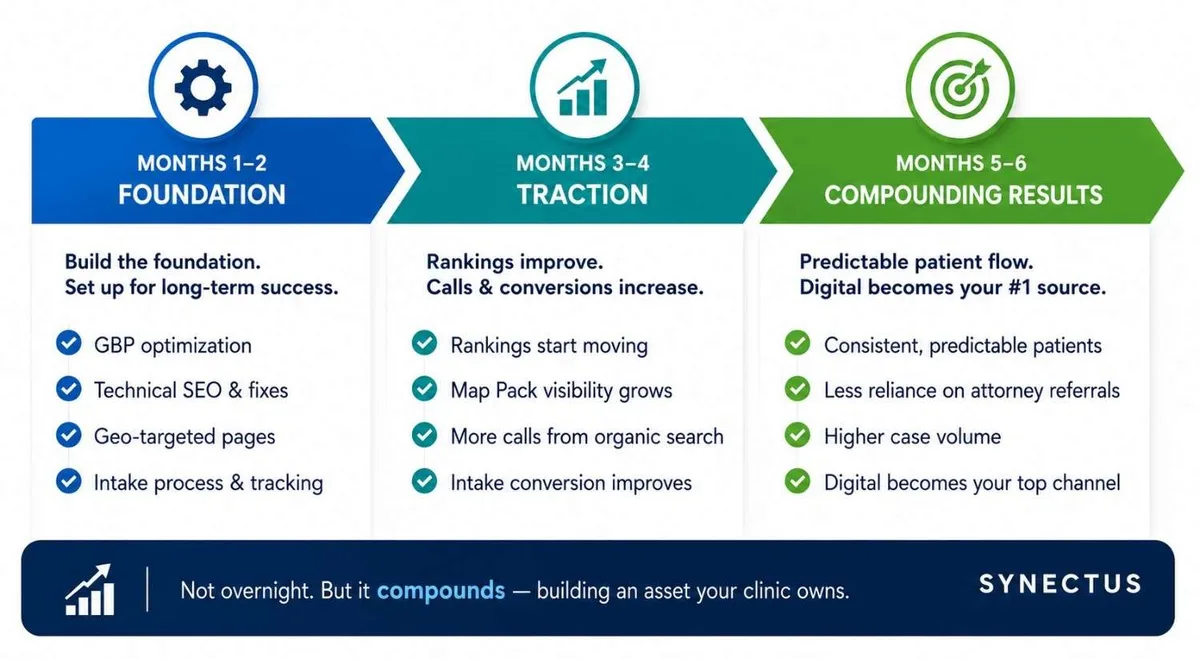
Clinic owners who've been burned by agencies before rightfully ask: what should I actually expect, and when? A well-executed personal injury clinic marketing Texas program doesn't produce overnight results — but it does produce compounding ones. Here's an honest, grounded timeline based on real Synectus client results across Texas markets:
Months 1–2: Foundation
This is infrastructure work, not glamorous but critical. Google Business Profile optimization, technical SEO audit and fixes, geo-targeted service page creation, intake process redesign, and call tracking setup. You won't see dramatic results yet — and any agency promising you otherwise is overpromising.
Months 3–4: Traction
Rankings begin moving. Your GBP listing starts appearing in Map Pack results for target keywords. Phone call volume from organic search increases. Intake conversion rates improve as the new process beds in. Attorneys may start asking where the new patients are coming from.
Months 5–6: Compounding Results
This is where the system pays off. Consistent, predictable patient flow from digital channels. Measurable reduction in attorney referral dependency. Higher case volume without proportional increases in overhead. For many Synectus clients, this is the point at which digital becomes their largest single patient acquisition channel.
The growth is not overnight. But it compounds — every month of SEO work and intake optimization stacks on top of the last, creating an asset your clinic owns, not rents.
Book a Free Strategy Call With Synectus Today
If you're still relying only on attorney referrals to fill your Texas PI clinic's schedule, you're one slow quarter away from a cash flow problem you didn't see coming. The clinics that will dominate Houston, Laredo, Beaumont, and every other Texas PI market over the next three years are the ones building their second patient channel right now.
Synectus has spent over a decade embedded in the Texas PI clinic world — not as a generic agency, but as a growth partner that understands LOP billing, intake urgency, attorney coordination, and what it actually takes to execute personal injury clinic marketing Texas at a level that produces real, measurable patient volume.
In a free 30-minute strategy call, we'll audit your current patient acquisition, identify exactly where you're leaving patients on the table, and show you what a second channel looks like for your specific market.
No long-term contracts. No bloated retainers. Just a clear plan for building the patient pipeline your clinic deserves.
Related reading
Next step
See how Synectus closes the handoff after the lead arrives.
If this article describes the exact gap inside your clinic, go one layer deeper into the service stack or book a direct strategy call with Synectus.